
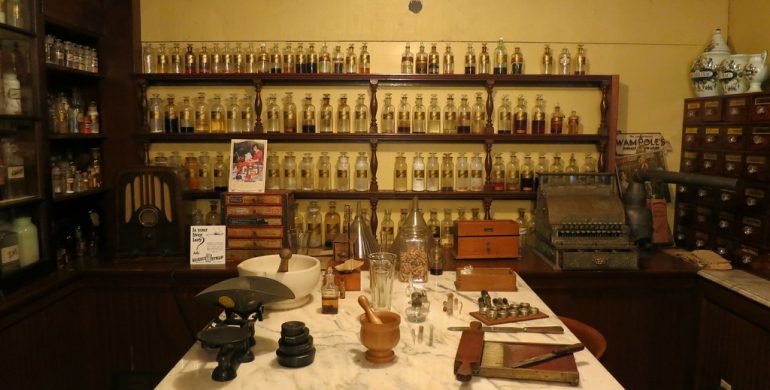
A hospital sees somebody once it is serious. You see them the same week, repeatedly, and for things nobody would go to a hospital for.
For a very large number of Nigerians the pharmacy or the patent medicine shop is the entire health system. It is also one of the few errands a controlled woman can run alone, which puts you in an unusual position whether or not you wanted it.
What comes across your counter
- Repeated purchases of painkillers, particularly by the same person over months.
- Requests for something for a bruise, a swelling, or a cut that ought to have been stitched.
- Antiseptic, dressings and bandages bought regularly by an adult with no obvious reason.
- Emergency contraception repeatedly, or a request for it alongside evident distress.
- Treatment for a sexually transmitted infection in a woman who says her husband is her only partner.
- Sleeping preparations or sedatives requested for somebody else.
- Somebody buying “for a friend” who is describing their own symptoms.
- A woman accompanied by a man who does the speaking and pays.
- Requests to buy medication for a child’s injury without the child being present.
- Somebody who is clearly unwell asking for something to manage rather than to treat, because a clinic visit is not available to them.
None of these is proof. What matters is the pattern and the discomfort, and you will usually notice both before you can articulate why.
The three things that matter most
One: know what is time critical. A great deal of what you see can wait. Three things cannot, and getting these right is worth more than everything else in this article.
- Pressure on the neck. Anybody describing being held, squeezed or pressed at the throat needs to be seen at a hospital the same day, even with no visible mark and even feeling well. Serious injury from strangulation frequently leaves nothing to see and can worsen over hours or days. Why this one is different is the most important page on this site.
- Any blow to the head, particularly with loss of consciousness, vomiting, confusion or worsening headache.
- After a sexual assault, where some treatment is time critical and measured in days. Emergency contraception is part of it and it is not the whole of it. Say that a hospital can offer more than you can, and say it quickly.
Abdominal pain, bleeding, injury during pregnancy and a wound that will not close all belong in the same category. What is time critical sets it out fully.
Two: create thirty seconds of privacy. Move to the end of the counter, take her into the dispensing area to check something, or simply lower your voice and turn slightly away from whoever is with her. That is often all that is needed, and it is completely unremarkable in your setting.
Three: ask one plain question. Not an interrogation. Something like: “Is somebody hurting you at home?” or “Are you safe at home?” Then stop and let the silence sit.
If the answer is no, accept it. “Alright. If that changes, you can ask me.” That sentence costs nothing and is remembered for years.
If somebody tells you
You are not being asked to be a counsellor, and four things done well are worth more than any conversation.
- Believe her and do not ask for detail you do not need.
- Say the one medical thing that matters if it applies — that she should be seen today, and why, particularly for the neck.
- Give her a route. Our number, 112, or a local organisation you know actually answers. Written on something that does not identify what it is.
- Do not tell anybody, including the person who came in with her, including a relative who asks afterwards, and including in an ordinary conversation about a customer.
Do not photograph anything, do not write her name in a record, and do not offer to speak to her husband.
Things to be careful of
Sedatives and sleeping preparations. Be cautious about supplying these for somebody who is not present, particularly where a man is buying for a woman or for a child. It is occasionally exactly what it appears to be.
Requests to help end a pregnancy. This is a difficult area and it is not one to manage across a counter. What is safe to say is that a hospital is the right place, and that she will not be turned away.
Somebody asking you not to give her something. A husband instructing you not to sell his wife medication is not somebody to accommodate.
Being asked whether she came in. The answer is that you do not discuss customers.
Practical things you can do that cost nothing
- Keep one number for this where you can find it, and 112.
- Keep a small card or slip you can hand over that does not announce what it is.
- Have somewhere in the shop a woman can stand out of sight of the door for a minute.
- Let somebody use your phone. Many women have no private way to call anybody, and this is one of the plainest things anybody can offer.
- If you employ staff, tell them that a customer’s business is not discussed, particularly with a spouse.
Why this matters more here than elsewhere
Because you may be the only person she speaks to alone all week, and because the alternative to you is nothing at all rather than a hospital.
A woman who cannot leave the house without explanation can usually buy medicine. That errand is unremarkable, it is short, and it is hers. The routes that still work when there is no privacy lists the pharmacy near the top for exactly that reason.
If you want to know more, or want to be somewhere we can send people, tell us. The article for clinicians covers the same ground for a hospital setting, and much of it applies to you.
Questions people ask
What is the one thing I should know medically?
That pressure on the neck needs hospital attention the same day even with no visible mark and even when the person feels fine. Serious injury from strangulation frequently leaves nothing to see and can worsen over hours or days.
How do I ask without embarrassing her?
Create thirty seconds of privacy by moving along the counter or taking her aside to check something, then ask one plain question and stop talking. If she says no, accept it and say the offer stands.
She says it is for a friend. What do I do?
Treat the advice as though it is for her, because it usually is. Say what you would say to the person affected, including anything that is time critical.
A man is buying sedatives for his wife who is not here. Should I supply them?
Be cautious. Supplying sedatives for somebody who is not present, particularly a woman or a child, is occasionally exactly what it looks like.
Her husband asked whether she came in. What do I say?
That you do not discuss customers. Do not confirm or deny, and tell your staff the same rule applies to them.
If you need help now
If you are in immediate danger, call 112. To talk to HealBridge, email us at hello@healbridge.org, or use the form on our contact page. Every page on this site has a Quick Exit button at the top right, and pressing the letter E three times does the same thing.
Before you rely on anything on this page
We publish these articles so that you can understand a subject and work out what to ask for. They are written carefully and in good faith. They are still general information about how things usually work, and not advice about your situation, which we do not know.
- This is not legal advice.
- We are not a law firm. Criminal law in Nigeria is largely a state matter, the VAPP Act applies in a state only if that state adopted it, and statutory, customary and Islamic marriages are governed by different law and different courts. Two people with the same facts can have genuinely different options. Get advice from a lawyer who practises where you live — and if cost is the obstacle, ask us, because arranging that is part of what we do.
- This is not medical advice.
- Nothing here is a diagnosis and nothing here replaces being examined. Do not delay seeing a doctor, nurse or pharmacist because of something you read here, and do not start, stop or change any treatment on the strength of it. If something is time critical, go and be seen.
- This is not counselling, and it is not financial advice.
- Articles about trauma, sleep, money, debt, renting or starting a business describe what commonly helps. They are not therapy and they are not a recommendation about your own money. Speak to a counsellor, a qualified adviser or your own bank about your circumstances.
- It may be out of date, or wrong for where you are.
- Law changes, services close, numbers stop answering and practice varies by state. We correct what we find, and we cannot promise that every page is current on the day you read it. Where we do not have something confirmed, we say so rather than fill the gap.
- Reading this does not make us your lawyer or your doctor.
- No professional relationship is created by reading an article, and we cannot accept liability for decisions taken on the strength of one. What we can do is help you reach somebody who is qualified to advise you, which is what the legal and health parts of our work exist for.
- We cannot promise an outcome, and we cannot make anybody safe.
- A protection order is a piece of paper backed by an enforcement system that is inconsistent. A plan works until the day it does not. Anybody in this field promising safety is selling something, and the promise itself is dangerous because it stops people planning.
Do not let this notice stop you acting. If you are in immediate danger, call 112. If something is medically urgent, go to a hospital — you do not need a police report to be treated. And if you do not know where to start, that is a normal way to begin: use the contact page and we will take it from there.
Also worth reading: