
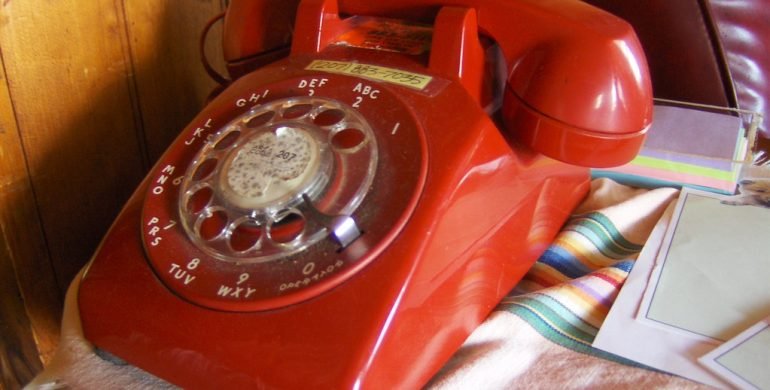
A great many women dial the number, listen to it ring, and put the phone down. Sometimes for months.
The reasons are consistent: not knowing what to say, not being sure it is bad enough, being afraid of what will be set in motion, and a suspicion that once you say it out loud you will have committed to something.
So here is the whole thing in advance, including the words, so that none of it has to be worked out while the phone is ringing.
The three things worth saying first
In this order, before any of the story.
1. Whether it is safe to call you back, and when. “Do not call this number.” “Only mornings.” “Only if a woman answers.” This is more important than anything else you could tell us, and it is the thing people forget under pressure.
2. Whether you can talk now. “I have four minutes.” “Somebody is in the next room.” That changes how the conversation runs.
3. What you want, or that you do not know. Both are complete answers.
Everything after that can be as little or as much as you like.
If you go blank
Very common. Any of these is enough to start with, and they are all real sentences that women have opened with.
- “I do not know if this counts.”
- “I am not ready to do anything. I just want to ask something.”
- “Things are not good at home.”
- “I need to know what would happen if I left.”
- “I am asking for a friend.” Which is fine, whether or not it is true.
- “I need somewhere to keep my documents.”
- “I cannot talk. Can I message instead?”
- “I do not know why I am calling.”
You do not have to describe anything that happened. Nobody will require an account of your marriage before helping, and there is no threshold you have to prove you have crossed.
What we will ask
Not much, and you can decline any of it.
A name to use. Any name. Plenty of women give one that is not theirs and that is entirely fine — we need something to call you, not your identity.
Which state you are in. This one genuinely matters, because the law and the services differ by state and it changes what we can tell you.
Whether you are safe right now, and whether children are with you.
How and when we may contact you.
That is the whole of it. Everything else is optional, marked optional, and nobody is asked why they left something out. What we record and why so little sets out the reasoning.
What we will not ask
His name. Your address, unless we are arranging something that physically needs it. A detailed account of what has happened. Photographs of injuries. Whether you have reported it. Why you have not left. Whether you are sure.
And we will not ask you to prove anything. There is no assessment of whether it was bad enough, because that is not a thing we do.
What will not happen
This is what stops most people, so it is worth being explicit.
Nobody will be contacted without your permission. Not the police, not a hospital, not your family, not your employer, not your pastor or imam. The single exception, stated so it is never a surprise, is where a child is at risk of serious harm or somebody’s life is in immediate danger — and if that arises we tell you we are acting and why.
Nobody will tell you to leave. A large proportion of the women we work with are staying, and the help is the same.
Nobody will ring you back if you say not to. Nobody will turn up anywhere. And nothing you say commits you to anything at all — a great many conversations end with somebody deciding to do nothing for now, which is a legitimate outcome rather than a failure.
How the call actually goes
Ordinary, and shorter than people expect. You say what you want to say, we ask two or three things, we tell you what is possible, and we agree what happens next or that nothing happens next.
You will probably be told some things you did not know — that a protection order does not end a marriage, that legal help can be free, that being married very young or not married at all does not change what is available. Those small pieces of information are frequently what the call turns out to have been for.
You may cry. Most people do at some point and it does not matter. You may also find you feel nothing at all and describe it flatly, which is equally normal and is not a sign that you are exaggerating.
If calling is not safe
Do not call. There are other routes and they work.
Message instead, from a device he does not check. Use the form on the contact page. Send an email from a business centre. Get somebody else to call on your behalf and pass on what we say. Or hand a written note to a clinician, a teacher or a pharmacist with your name, one line about what is happening, and when it is safe to reach you.
The article for women with no privacy covers all of this, including what to do with a five-minute window.
Two things to be clear about
We are not an emergency service. If something is happening now, call 112. We are for everything that comes after tonight. Which number does what is set out separately.
We may not be the right service. If we are not, we will say so quickly rather than after three weeks, and try to say where else. How we handle that is written down so it does not depend on who answers.
If you are not going to call yet
That is common and it is not a failure. Most people who eventually get in touch thought about it for a long time first.
Two things worth doing in the meantime, both of which cost nothing: memorise 112, and know that a service exists that will not contact anybody without your permission and does not require you to be leaving. When a moment comes, it will still be here.
Questions people ask
What if I do not know what to say?
Say that. “I do not know if this counts” and “I do not know why I am calling” are both complete openings. Tell us when it is safe to call you back before anything else.
Do I have to give my real name?
No. Give any name you want us to use. We need something to call you, not your identity, and nobody will check.
Will you call the police or tell my family?
Not without your permission. The only exception, stated so it is never a surprise, is a child at risk of serious harm or somebody in immediate danger — and we would tell you we were acting and why.
Will you tell me to leave him?
No. A large proportion of the women we work with are staying and the support is the same. Nothing you say on the call commits you to anything.
What if I cannot safely make a call at all?
Message from a device he does not check, use the contact form, email from a business centre, ask somebody to call for you, or hand a written note to a clinician, teacher or pharmacist.
If you need help now
If you are in immediate danger, call 112. To talk to HealBridge, email us at hello@healbridge.org, or use the form on our contact page. Every page on this site has a Quick Exit button at the top right, and pressing the letter E three times does the same thing.
Before you rely on anything on this page
We publish these articles so that you can understand a subject and work out what to ask for. They are written carefully and in good faith. They are still general information about how things usually work, and not advice about your situation, which we do not know.
- This is not legal advice.
- We are not a law firm. Criminal law in Nigeria is largely a state matter, the VAPP Act applies in a state only if that state adopted it, and statutory, customary and Islamic marriages are governed by different law and different courts. Two people with the same facts can have genuinely different options. Get advice from a lawyer who practises where you live — and if cost is the obstacle, ask us, because arranging that is part of what we do.
- This is not medical advice.
- Nothing here is a diagnosis and nothing here replaces being examined. Do not delay seeing a doctor, nurse or pharmacist because of something you read here, and do not start, stop or change any treatment on the strength of it. If something is time critical, go and be seen.
- This is not counselling, and it is not financial advice.
- Articles about trauma, sleep, money, debt, renting or starting a business describe what commonly helps. They are not therapy and they are not a recommendation about your own money. Speak to a counsellor, a qualified adviser or your own bank about your circumstances.
- It may be out of date, or wrong for where you are.
- Law changes, services close, numbers stop answering and practice varies by state. We correct what we find, and we cannot promise that every page is current on the day you read it. Where we do not have something confirmed, we say so rather than fill the gap.
- Reading this does not make us your lawyer or your doctor.
- No professional relationship is created by reading an article, and we cannot accept liability for decisions taken on the strength of one. What we can do is help you reach somebody who is qualified to advise you, which is what the legal and health parts of our work exist for.
- We cannot promise an outcome, and we cannot make anybody safe.
- A protection order is a piece of paper backed by an enforcement system that is inconsistent. A plan works until the day it does not. Anybody in this field promising safety is selling something, and the promise itself is dangerous because it stops people planning.
Do not let this notice stop you acting. If you are in immediate danger, call 112. If something is medically urgent, go to a hospital — you do not need a police report to be treated. And if you do not know where to start, that is a normal way to begin: use the contact page and we will take it from there.
Also worth reading: